- Home All posts
Sunday's Numbers Have Been Crunched
Cam Newton: The Best First Two Seasons Ever
This Sunday, Cam Newton will finish his second NFL season. As the final whistle blows in the Panthers' final 2012 contest against New Orleans, Newton will have finished the greatest first two seasons we've ever seen out of an NFL quarterback. And at least in the realm of the regular season, it isn't particularly close.
Newton enters Sunday with the following career statistics: 574-for-969 passing (59.2 percent), 7,672 yards, 40 touchdowns, 28 interceptions; 246 rushes for 1413 yards (5.7 per carry) and 22 more touchdowns. Newton's 8,584 net yards -- including 70 sacks taken for 501 lost yards -- the Panthers star has an exactly 800 yard lead on Peyton Manning's old 7,784 net yardage mark, the previous best for any quarterback in his first two seasons. Newton still has one game left.
Newton's 7.9 yards per attempt ranks fourth (Ben Roethlisberger, Dan Marino, Mark Rypien). His 62 total touchdowns ranks second (Marino). Newton's only major category away from the top: a 2.8 percent intereception rate, still 16th of the 78 quarterbacks since 1933 to start at least 20 games in their first two seasons. Only Andy Dalton attempted more passes than Newton of those above him on the list.
My Gift to Football Columnists: The Sports Column Generator
Life is especially tough for columnists because so much of what happens on a football field can't be pinned down to any particular cause. A plausible narrative has to be invented and defended. After all, an essay like this doesn't fill up many column-inches:
Localtown, ST -- Sometimes our hometown team has two turnovers, sometimes it has one, and sometimes it has none. Sunday, it had two, one fumble and one tipped pass for an interception, and that's probably why they lost. The end.
Season after season of regurgitating the same narratives must get old, and I'm sure sometimes columnists feel like they could be replaced by a robot. Well, now they have.
Team Efficiency Stats - Week 17
Here are the team efficiency rankings heading into week 17. See the second table below for the raw inputs. Click the table headers to sort.
Sunday's Numbers Have Been Crunched
Calvin Johnson's Receiving Record and "Stats"
But the truth is that the record for most receiving yards (or rushing yards or whatever yards) is not "a statistic." It's trivia. It's the answer to a question on the ESPN sports-trivia-a-day calendar you just bought for your nephew for Christmas. It's the kind of thing that gives stats a bad name, or at least a misleading one.
Don't get me wrong. I think Calvin Johnson is awesome, and all the numbers agree. Fans and media are right to make a big deal out of such an accomplishment. It's just that records like this are what most people think of when they hear the word statistics. It's understandable then, that when coaches or players think of stats, they dismiss them as pointless or "for losers." After all, how could knowing who holds the record for most receiving yards in a season, or memorizing how many yards that is, possibly help a team win?
How Much Is Joe Flacco Worth?
Statistically, he's just as hard to figure out. Among all QBs since 2008, when Flacco entered the league and began his uninterrupted starting streak, his WPA has exceeded his EPA. Of the 30 QBs with the most attempts since 2008, Flacco has the 3rd highest ratio of WPA to EPA. Most observers would call him "clutch."
Based on the recent historical relationship between QB performance and salary, we can estimate Flacco's market value. But depending on how we value his production, we get very different salary values.
Flacco is remarkably consistent. Receivers come and go, and lineman come and go, but since his rookie year Flacco is a rock solid 70 EPA per year guy. Adjusting for team cap inflation, that makes Flacco worth approximately:
The Jets' Post-Mark Sanchez Landscape
Congratulations are in order for Mark Sanchez. The erstwhile Jets starter joins an exclusive club this season, as he becomes one of four quarterbacks since 2000 to post four consecutive seasons with a 0.05 EPA/P or worse:
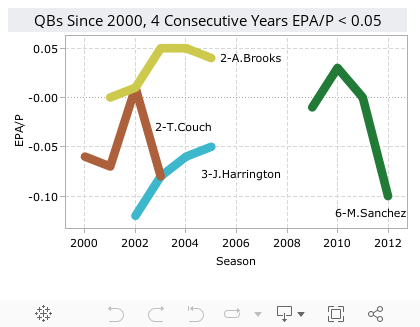
Mark Sanchez. Aaron Brooks. Tim Couch. Joey Harrington. It's a remarkable list* not because of how bad these players were but because of how long their teams decided to stick with them. But this is sometimes the trap teams fall into with quarterbacks -- they become pot committed, too invested in the quarterback's success to back out and push the reset button.
*We could probably add Jake Plummer to it if we had EPA data for the 1999 season, as he carried a streak from 2000-2002.
The immediate aftermath for the three other squads has not been pretty. They combined to win just 17 games over the next three seasons combined, for an average record of 5.7-10.3. Only the Saints managed to pull themselves out of the mess thanks adding Drew Brees and Sean Payton before the 2006 season -- and they still missed the playoffs in two out of the three seasons.
What sets Brooks apart from Couch and Harrrington (and Sanchez) is Brooks wasn't a first round pick. He was a fourth-round third-stringer acquired from the Packers and he only earned a start with the Saints thanks to injuries. Brooks ran with the opportunity and turned it into five seasons as the Saints' starting quarterback.
The Browns and Lions, on the other hand, given the investment (both in terms of money and the early draft pick) in their failed quarterbacks, had much farther to climb to get back to respectability. Both have made just one playoff appearance since, and the clubs have combined to average under five wins per season each.
Could the Jets be in for a similar down period in Sanchez's wake? To get more than just two other quarterbacks to compare him to, let's look at first-round drafted quarterbacks to stay with the same team and post a 0.05 EPA/P or worse for three consecutive years (instead of Sanchez's four):


